
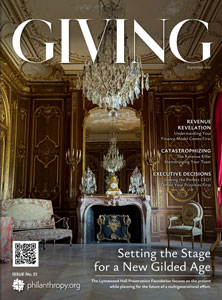
Visionary Voices

Visionary Voices is philanthropy.org’s editorial forum for serious ideas, hard-earned lessons, and informed perspectives shaping the future of philanthropy. It is a place for practitioners, leaders, and thinkers to examine what works, what doesn’t, and why.

Contributions explore strategy, governance, donor engagement, ethics, and the structural forces influencing philanthropy today. Articles are grounded in experience, analysis, and reflection—not promotion.

If you’ve developed insight through practice, research, or leadership, we welcome thoughtful submissions that advance credible dialogue and long-term thinking in the field.

Browse by Topic
Yellow "Tax Form 990" sticky note on a keyboard, illustrating how nonprofits can use Form 990 as a marketing tool

Good News: The IRS Joined Your Marketing Team

The IRS made your Form 990 public — and donors, advisors, and watchdogs are reading it. So why settle for a dull tax form? CPA Andrew Gray lays out three ways nonprofits can turn the 990 into a marketing asset: know your audience, treat the first pages like a brochure, and file a clean, accurate return that builds trust.

Read More »
Thoughtful donor at home considering whether to leave a bequest to a charity

Is Your Charity Actually Ready for Your Bequest?

You’ve given to this cause for years. Now you’re weighing something far larger — a bequest from your estate. But a planned gift isn’t simply a bigger check, and a charity that can ask for one isn’t always built to receive it. Before you sign, learn the questions that reveal whether your charity is genuinely ready for your legacy — or merely ready to request it.

Read More »
A single classical column on bedrock supporting a city skyline, illustrating a nonprofit board's fundraising responsibilities.

Give, Get, Govern

Most trustees think board fundraising means writing a check they can’t afford and begging strangers for money. Wrong on both counts — and that misunderstanding is quietly costing your organization its largest gift. The real duty isn’t giving or getting. It’s governing: setting the vision, funding the work, protecting the long horizon. A board that thinks only about this quarter starves the gift it will never see coming.

Read More »
Older and younger woman sharing coffee and warm conversation — the consistent relationships behind strong donor retention

Tools Have Done Their Job. Now We Must Do Ours.

Modern tools have solved access, cost, and complexity — yet donor retention stays low and giving stays episodic. The limiting factor is no longer capability; it’s consistency. Over twelve months, one zero-staff nonprofit reinvested the time tools saved into relationships, reaching 98% donor retention and 81% recurring giving on a $10,000 budget. The deeper lesson reaches all the way to planned giving: tools enable the work, but only people build trust.

Read More »
A wooden signpost indicating the paths to consistency, patience and discipline.

The Missing Discipline in Today’s Wealth Transfer

Thoughtful, measured estate planning takes discipline and a plan. The intentional transfer of values begins with establishing a family narrative and helps to create a lasting family legacy. When families define their “why” and articulate a shared mission, they connect generations to a deeper purpose that extends beyond wealth preservation.

Read More »
Red carpet with velvet rope barriers symbolizing donor exclusivity and major gift fundraising concentration

The Sector Is Concentrating Its Way Into Fragility

The FEP just reported the strongest giving growth in five years. The sector exhaled. I didn’t. Revenue is up because a smaller group of major donors gave more. The donor base shrank again. Concentrated revenue is brittle revenue. The money is concentrated at the top. The mission lives in the many. That gap is the work.

Read More »
EKG heart-rate line transitioning from chaotic spikes to a steady pulse, illustrating recurring giving and donor retention.

Fundraising’s Acute-Care Problem — and the Cure

For decades the nonprofit sector optimized for the first gift. We mastered the handshake. But sustainable fundraising depends on what follows. The GIVE Framework — Gratitude, Impact, Voice, Engagement — argues that recurring giving is not a payment mechanism but an identity shift, built through consistency rather than urgency. From a physician-run foundation that converted a majority of donors to recurring giving without staff or overhead. A clear-eyed account of where the model works, and where it doesn’t.

Read More »
>